

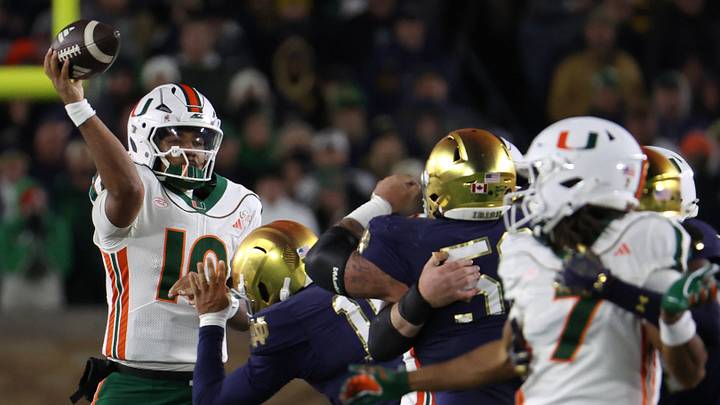
The Miami Hurricanes joined the ranks of the once-beaten and will likely fall from their No. 1 perch atop the CFP rankings after a 31-24 loss to No. 11 Notre Dame. Much like last season's back-and-forth battle, this one came down to the wire. The only difference is that it was Miami trying to make a mad comeback and, much like Notre Dame's fate a year ago, the Hurricanes fell short.
Despite the loss, Miami is still in a great position with regard to the CFP and is still in position to make the ACC Championship Game with three games remaining. Things were expected to be tough without the services of Malachi Toney, and they were, but there were plenty of things to build on as some players stepped up to the challenge and will be relied on heavily moving forward.
Here are four reasons why Miami fell short in its comeback attempt against Notre Dame:
Slow start foiled gutsy comeback attempt
Miami has been known for its fast starts this season, but Week 10 was a different story. The Hurricanes had lackluster possessions on offense and found themselves down 10-0 before the offense really got some momentum going. The defense wasn't much better; giving up a touchdown drive coming out of halftime to go down 24-3 was a killer.
With that being said, the rest of the third quarter was excellent. The defense got some stops, and Darian Mensah got hot, throwing touchdowns to Cooper Barkate and Elija Lofton. But Mensah threw an interception on a rare bad decision, and a fourth-down coverage bust led to another Irish touchdown and a 14-point lead they would not relinquish.
Darian Mensah had early trust issues
Notre Dame was giving Miami a ton of man coverage through the first two and a half quarters, and it took Mensah a while to figure out what to do. Eventually, he and Barkate got on the same page, and Lofton proved to be a reliable secondary receiver. But the rest of the Miami pass catchers had very little to offer. Daylyn Upshaw had a drop in the second half, and the running backs didn't offer much help by catching passes out of the backfield.



We thought Barkate would be the guy moving forward, and that appears to be the case after he had 10 catches for 118 yards and two touchdowns. Also, there's hope that Lofton's big game (7 catches, 113 yards, TD) will be a sign of things to come because the other Hurricane receivers were not up for the challenge.
But Mensah's lack of composure late in the game worries me. On Miami's final drive, he took a bad sack to start the possession and, after converting a first down, he decided to run a play instead of clocking the ball and resetting the offense with what would have been around 10 seconds. The decision to run a play was likely a coach's call, but he had to make the decision to override that call at that moment because the Miami offense wasn't ready, and it showed.
Javian Mallory needed more touches
The freshman running back got on the field in the red zone and was productive, but Shannon Dawson decided not to use him anywhere else, and it made no sense. Jordan Lyle got the early RB2 reps and didn't do much with them; plus, he dropped a pass in the fourth quarter that would have been a nice gain.
This isn't to knock Lyle as much as it is to wonder why Dawson didn't give his dynamic freshman more opportunities. The glaring example would be that disastrous third-and-goal call in the first half, where Mensah failed to score on a QB sweep.
CJ Carr had his way with the Miami secondary
We knew that the Miami pass defense had to be much better after Billy Edwards picked them apart in Week 9, but they weren't and CJ Carr looked every bit like the Heisman contender that the college football media claims he is. Carr was 29-of-40 for 319 yards and three touchdowns. Most of his damage was done in the first two and a half quarters, but every time Carr needed to get something through the pass game, he got it.
The Hurricanes might not face another quarterback who can exploit them in their final three games, but these issues with pass defense are not going to go away.
 Add us as a preferred source on Google