

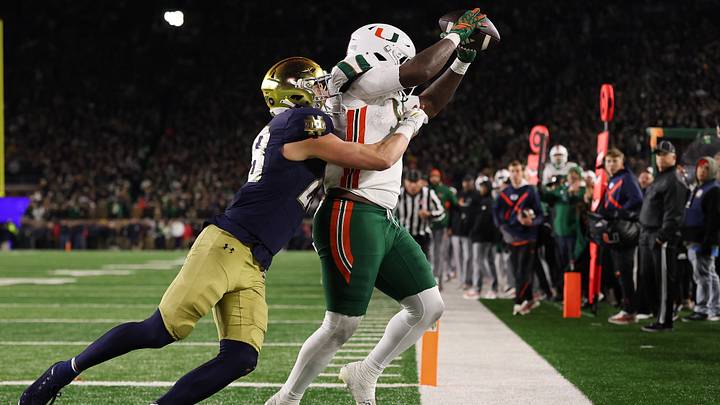
It looked like a touchdown, but the ACC referees said it was an incomplete pass. Then they went to an official review and upheld the ruling on the field.
Of course, we could not hear the discussion in the review because it was a non-conference game. And if we're being honest, the whole thing seems a little suspicious.
It's been almost 24 hours since the Miami Hurricanes suffered their first loss of the season, falling 31-24 to Notre Dame, and Elija Lofton's controversial non-touchdown call is all anyone can talk about. We can look at a million different replays and angles, and you either think it was a clean catch or not. Had the officials called it a touchdown on the field, I don't think it would've been overturned.
Did Miami's Elija Lofton catch a touchdown against Notre Dame?#GoCanes #Miami #GoIrish pic.twitter.com/aKhKhRYBJv
— SVPod (@_SVPod) November 8, 2026
But what is a catch in college football, and why is it such a judgment call?
The NFL has a pretty decisive catch rule — firm control of the ball, two feet in-bounds, and make a football move (tucking the ball, etc.) or maintaining control of the ball to the ground. It's a three-part checklist.
College football also has a three-part checklist as defined by NCAA rule 2-4-3, and it's pretty similar: firm control and having one foot in bounds, as college rules state, but it's that third part that leaves a lot of wiggle room, and it's in what's defined as the "game act".



Elija Lofton's TD catch was good according to the 'game act'
The "game act" is executed if a receiver has firm control while getting a foot down and has time to switch the ball or brace for a hit. Let's look at the play again:
Elija Lofton scored on this in my opinion.
— Reason (@the_real_reason) November 8, 2026
I have no allegiance in this, I just want to see good football.
That’s two feet in and it’s knocked out after he’s out of bounds.
Should have been 6. pic.twitter.com/Cn7zcc3k5x
Lofton has control of the ball, and his feet are down cleanly. Is Lofton still in control of the ball when he steps out of the end zone? Because if that's the case, the play has to be dead and that's a touchdown. But Mario Cristobal warned us of potential shenanigans at Notre Dame, as did Jimmy Johnson in 1988, when the then-No. 1 Hurricanes were robbed by the officials in a 31-30 loss to the Fighting Irish.
"Really, really disappointed that they negated Elija Lofton's touchdown with two hands on the ball and two feet in bounds," Cristobal said in postgame comments. "But, like we told our team before we left Miami, do not leave it in the hands of the officials because that's what you're going to get out here."
As frustrating as the end result is, complaining will not make things any better. We know what we saw, and we know what the officials ruled. It stinks because Miami did so much to rally and try to tie that game, but we also saw the Hurricanes shoot themselves in the foot repeatedly to get into a 24-3 hole. The mistakes in the secondary and with pass protection had nothing to do with the referees missing calls.
The best thing that can happen is for Miami to close strong, much like it did last season. Win these final three games, win the ACC Championship on Dec. 5, and that will guarantee entry into the CFP 12-team bracket. However, if the Hurricanes don't complete this three-step process, one missed call will turn into a lost season.
 Add us as a preferred source on Google