

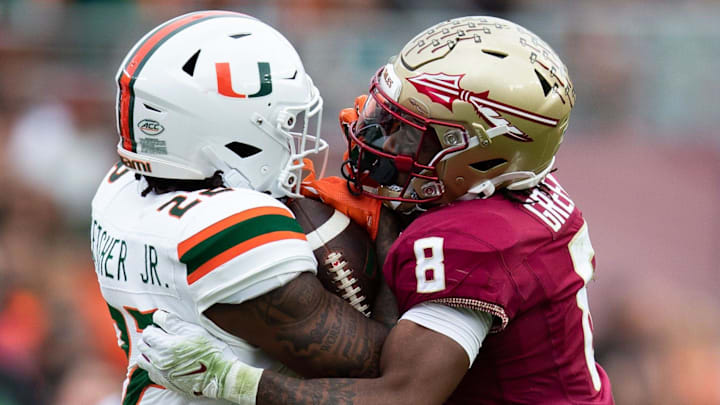
A recent thread on X sparked a debate between Miami and Florida State fans, all stemming from a hot take by an FSU fan: no Hurricanes team in program history could ever beat the 2013 national-champion Seminoles.
Just watched some tape… and yeah, that 2013 FSU beats any Miami team OAT and that’s not even the best FSU team all time…
— Atlanta Nole 🍢 (@nole_atl) February 5, 2026
But every Miami fan has one team in the back of their mind; it is a squad so overwhelmingly dominant it’s become the gold standard of college football excellence: the 2001 Miami Hurricanes, an undefeated national champion widely regarded as one of the greatest teams in the history of college football.
The 2013 Florida State Seminoles were great. That’s undeniable. Jameis Winston won the Heisman. They were balanced, explosive, well-coached, and ruthless against nearly everyone on the schedule. Undoubtedly, the Seminoles had a talent level stacked well against their contemporaries.
But comparing a strong modern champion to a historically loaded roster creates separation quickly.
And that’s where the 2001 Miami Hurricanes enter the picture — the very team Miami fans immediately point to, and the one most analysts still regard as the benchmark for peak collegiate dominance.
A roster built on NFL firepower
Both teams were built on deep, well-developed rosters. The 2013 Florida State team had legitimate NFL talent at nearly every position, and their balance on offense and defense was one of the defining traits of that championship run. They were deep by any modern standard.
The separation comes from scale. The 2001 Miami Hurricanes carried a level of roster depth that extended far beyond their starting lineup. They produced more than 40 NFL players, including 15 first-round draft picks, and several future All-Pros who were backups on the Miami roster during the season. That type of depth is rare even by historical standards. It wasn’t just a good starting unit. It was a roster where second-string players went on to become NFL starters. That level of saturation is the primary reason analysts and scouts consistently cite Miami as one of the most complete teams ever assembled.
Dominant performance throughout the season
Miami didn’t just win games; they overwhelmingly controlled them. The Hurricanes finished 12–0, and during that season, they scored crushing victories over ranked opponents, including a 49–27 win at Florida State. They also recorded massive wins over Top 15 teams like Syracuse and Washington by a combined 124–7, an NCAA record for back-to-back dominant margins against ranked opponents.
These results weren’t close calls. They were authoritative. The average margin of victory for Miami was near 30 points per game, a level of season-long dominance that few national champions achieve even in their championship years.
Comparing schedule strength and context
Some critics of the all-time status of the 2001 Miami focus strictly on the strength of schedule. Even accounting for that context, statistical evidence from the period suggests Miami played against teams with stronger overall records than Florida State did in its 2013 title run. One contemporary comparison noted that the Hurricanes’ opponents had better average offensive and defensive rankings than Florida State’s schedule that season.
In other words, Miami’s dominance came against a similarly, or more, challenging slate of competition, not just a weak set of opponents.
Why that matters in a hypothetical cross-era matchup
If you anchor this matchup in tangible factors observable across eras — roster depth, dominance of performance, production of professional talent, and consistent control of games — the argument favours the Hurricanes. They didn’t merely have stars; they had strength in every unit, consistently overwhelming their opponents with physicality and speed. That kind of structural advantage isn’t a minor edge; it’s the difference between a great team and a historically exceptional one.
This isn’t just based on Miami fandom. It’s the same basis on which many analysts and fans consider the 2001 Hurricanes a standard by which other championship teams are measured.
 Add us as a preferred source on Google