

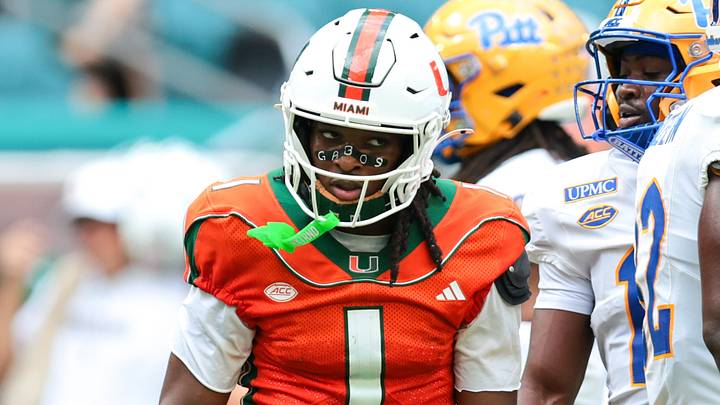
Notre Dame coach Marcus Freeman has every reason to prepare his team for a difficult matchup against No. 1 Miami on Saturday, but his comments about injured Hurricanes receiver Malachi Toney crossed a line that should have been easy to avoid.
With multiple reports confirming that Toney suffered a high ankle sprain requiring surgery, Freeman publicly entertained the possibility that Miami's leading receiver could still play, unnecessarily raising doubts about a serious injury.
NEW: Notre Dame head coach Marcus Freeman says the Irish will still prepare for Miami's Malachi Toney despite his injury:
— On3 (@On3) November 5, 2026
"We’ll see if he plays or not. We have to make sure we have a plan if he plays, if he doesn’t, we’ll adjust."
(via @PeteSampson_)https://t.co/oRmJQf5Nw5 https://t.co/ZT4vz2IFvO pic.twitter.com/B7eC55FTTd
Freeman wants ND to stay ready for Toney despite surgery
"We'll see if he plays or not," Freeman said Thursday. "We have to make sure we have a plan if he plays, if he doesn't, we'll adjust."
On the surface, the comments might sound like ordinary coach speak, especially with Notre Dame preparing for one of its most important games of the season. But there is a meaningful difference between respecting an opponent's depth and suggesting that a player facing surgery could unexpectedly appear on the field two days later.
Toney injured his ankle during Wednesday's practice, prompting further medical evaluation that revealed the need for a TightRope procedure.
Numerous outlets independently reported that the injury would sideline Toney for multiple weeks, with a potential return during the CFP remaining the earliest timeline. Miami also acknowledged the injury on Wednesday, and stated that additional updates would be shared when appropriate.



Despite that information, Freeman continued discussing the possibility of Toney playing Saturday, creating an unnecessary opening for speculation about the legitimacy of Miami's injury reporting.
Similar comments were also made by former Notre Dame QB Brady Quinn. During Thursday's edition of 2 Pros and a Cup of Joe, Quinn questioned whether Miami might be attempting an elaborate deception ahead of the rivalry game, suggesting that the absence of mandatory player availability reporting for non-conference games could allow such a maneuver.
"I'm still even skeptical," Quinn said. "Like this is one of those things in college football where until I don't see him on the field Saturday night, I will not believe it."
Quinn is now a sports commentator whose job involves offering opinions and generating discussion. His theory is questionable given the medical reporting, but listeners understand that he is speculating rather than speaking on behalf of a football program.
Freeman's comments carry considerably more weight. When Freeman says his staff must prepare for the possibility of Toney playing, it gives an otherwise unsupported theory a level of credibility that speculation from a television or radio personality does not carry.
Freeman could have explained that Miami has talented receivers capable of replacing some of Toney's production, that the Hurricanes' offensive system remains dangerous, or that Notre Dame's defensive preparation would not change substantially regardless of personnel. Any of those responses would have conveyed the same competitive message without entertaining the possibility that a player undergoing ankle surgery might somehow return within days.
It shows little consideration for Toney himself, who is dealing with a significant injury at one of the most important moments of his young career. The comments are also unfair to Mario Cristobal and Miami's medical staff.
There is no credible evidence that Miami has misrepresented Toney's condition, and the absence of an ACC-mandated availability report for a non-conference game does not provide grounds for suggesting otherwise.
Freeman has every right to prepare for unexpected personnel changes, and no one would criticize Notre Dame for having contingency plans behind closed doors. The issue is his decision to publicly present Toney's participation as a possibility when the available medical reporting overwhelmingly indicates otherwise.
 Add us as a preferred source on Google