

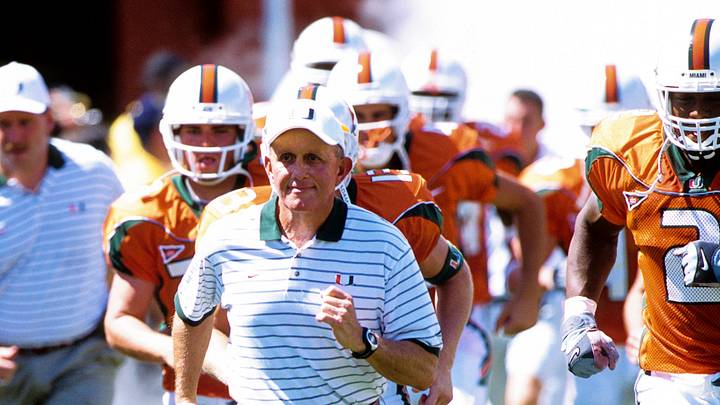
Miami will celebrate the 25th anniversary of its 2001 national championship team when Pittsburgh visits Hard Rock Stadium on Oct. 24. The ceremony will bring back the familiar conversation around one of college football's most loaded rosters, a group that finished 12-0, beat Nebraska 37-14 in the Rose Bowl and set a standard that few teams have approached since.
The 2001 roster eventually produced 17 first-round NFL draft picks and 38 total draft selections. That volume of proven professional talent separates the 2001 group from almost every championship team in modern college football, including Miami's current roster.
There are, however, parts of the 2001 formula that fit the way Miami has built its 2026 team. The Hurricanes enter the season with a veteran quarterback, a proven running back, a receiver capable of carrying the offense and defensive playmakers at every level.
How the 2001 Miami blueprint could apply to 2026 Miami
In 2001, Ken Dorsey threw for 2,652 yards and 23 touchdowns during the 11-game regular season. Clinton Portis rushed for 1,200 yards and 10 touchdowns, Frank Gore added 562 yards while averaging 9.1 yards per carry, and Willis McGahee contributed 314 rushing yards in eight games. Andre Johnson caught 37 passes for 682 yards and 10 touchdowns, while Jeremy Shockey had 40 receptions for 519 yards and seven scores.
Miami averaged 43.2 points per game in the regular season, rushed for 204.6 yards per game and threw for 250.2. The Hurricanes produced 25 rushing touchdowns and 24 passing touchdowns before the Rose Bowl.
The 2026 Hurricanes have a similar offensive setup.
Darian Mensah arrives after throwing for 3,973 yards and 34 touchdowns in 2025. Mark Fletcher Jr. is back after rushing for 1,192 yards and 12 touchdowns, and Malachi Toney returns after catching 109 passes for 1,211 yards and 10 touchdowns as a true freshman.
The defensive comparison is harder to make, though the current roster has pieces that could shape a disruptive unit.
The 2001 defense overwhelmed opponents. Miami recorded 39 sacks and 27 interceptions in 11 regular-season games. The Hurricanes held opponents to a 44.5% completion rate, allowed only five passing touchdowns and gave up 9.4 points per game. Ed Reed had nine interceptions, while William Joseph posted 10 sacks, Jerome McDougle had six and Jamaal Green added six.
Miami's 2026 defense has to replace a large amount of departed production, particularly up front. Ahmad Moten Sr. returns after earning second-team All-ACC honors, Damon Wilson II joins the Hurricanes after recording nine sacks at Missouri last season, and Bryce Fitzgerald is a proven ball hawk in the secondary after tying for the ACC lead with six interceptions as a freshman.
The 2026 team has a chance to follow parts of the 2001 blueprint, even if the squad doesn't have 17 first round picks on the roster.
 Add us as a preferred source on Google