

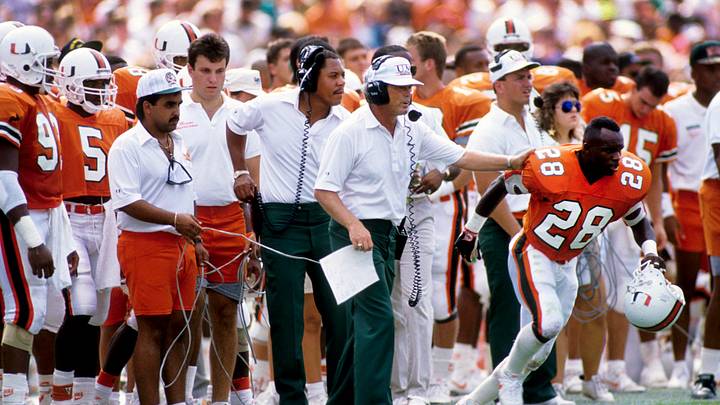
Ryan McGee's ranking of college football's greatest supervillains ran at ESPN this week, and Miami's 1990 team came in at No. 5, the only single-season team on a list that also found room for Notre Dame at No. 6 and ESPN itself at No. 7.
It is a good excuse to go back and look at that season. Most people who know the 1990 Hurricanes know one number and one image: 202 penalty yards, and Randal Hill firing imaginary pistols at the Texas sideline.
What gets lost is the team those things happened to belong to, and how much of modern college football still runs on rules written in response to one January afternoon in Dallas.
The story of the 1990 Miami Hurricanes
Miami opened 1990 ranked No. 1 as the defending national champion, then lost 28-21 at BYU in the season opener, with Ty Detmer on his way to the Heisman Trophy.
The Canes recovered in the following weeks. They ran California off the field 52-24 in Berkeley, beat Iowa 48-21, and took down No. 2 Florida State 31-22 in the Orange Bowl. Then came Oct. 20 in South Bend, where Notre Dame beat them 29-20 behind five Craig Hentrich field goals and a 94-yard kickoff return touchdown from Raghib Ismail.
Miami won its remaining games, including 45-0 over Pittsburgh, and finished the regular season 9-2 and ranked No. 4.
The Hurricanes believed they were still the best team in the country and wanted a shot at the title in their own Orange Bowl. Instead they were sent to Dallas to play No. 3 Texas in the Cotton Bowl on Jan. 1, 1991, with the championship elsewhere.
Matchup against No. 3 Texas
Texas offensive lineman Stan Thomas gave an interview during bowl week describing Miami players wearing bandanas at a barbecue as looking like they belonged in prison. Miami spent the next several days planning what to do about it.
The Hurricanes ran onto the field first and formed a taunting reception line at midfield for the Longhorns to run through. On the opening kickoff, Robert Bailey knocked Texas returner Chris Samuels down at the 14-yard line and left him unable to stand. Before Miami ran a single offensive play, it had already been assessed 30 yards in personal foul and unsportsmanlike conduct penalties following the first Texas punt.
By halftime, Miami led 19-3 and had been flagged 10 times for 132 yards.
The signature moment came late in the third quarter. Craig Erickson hit Randal Hill for a 48-yard touchdown and Hill kept running, through the end zone and up the tunnel. He walked back onto the field, drew a pair of imaginary six-shooters and fired them at the Texas sideline. It made the score 33-3.
Miami won 46-3, the most lopsided result in the bowl's 55-year history at that point. Erickson threw for 272 yards and four touchdowns, a Cotton Bowl record. Texas managed 55 passing yards. And the Hurricanes finished with 202 penalty yards on 15 flags, both Cotton Bowl records, and most of them were for unsportsmanlike conduct or personal fouls.
January 1, 1991
— Old Time Football 🏈 (@Ol_TimeFootball) August 25, 2024
55th Cotton Bowl Classic#Miami #Texas #GOTW
Randal Hill catches a 48 yard TD
Darrin Smith pick 6
Hurricanes set school record for penalties (15) and most penalty yards (230).
OMVP Craig Erickson
DMVP Russell Maryland
46-3 #TheU pic.twitter.com/LDsETKoMev
Miami's controversial and dominant Cotton Bowl performance outshines the rest of that season
The penalty total overshadowed the football that was played, which is a shame, because the 1990 Hurricanes were loaded.
Russell Maryland won the Outland Trophy after posting 96 tackles and 10.5 sacks, becoming the first Miami player ever to win the Outland. That April he went No. 1 overall to Dallas, the second Hurricane in program history to go first overall after Vinny Testaverde.
Randal Hill went 23rd overall to the Dolphins in the same first round. Carlos Huerta was kicking, Lamar Thomas and Wesley Carroll were catching, Leon Searcy was blocking, and Miami finished No. 3 in both final polls at 10-2.
Dennis Erickson's assistants that season included defensive coordinator Sonny Lubick, offensive coordinator Bob Bratkowski, linebackers coach Tommy Tuberville, defensive line coach Ed Orgeron, and offensive line assistant Art Kehoe. Orgeron would win a national title of his own at LSU 29 years later.
And this group, which went 21-3 across 1989 (national champions) and 1990, set up the 1991 team that finished 12-0 and won the national championship.
The lasting legacy
Following the Cotton Bowl, the NCAA introduced its first taunting and celebration standard, widely nicknamed the "Miami Rule," which made excessive celebration and flagrant taunting a 15-yard unsportsmanlike conduct penalty. It went into effect for the 1991 season.
For the 2026 season the NCAA trimmed its list of automatic unsportsmanlike conduct fouls and directed officials to concentrate on taunting aimed at an opponent, actions that interfere with game administration, and celebrations demeaning to the game or the opponent.
Brandishing a weapon in any form is an automatic flag.
 Add us as a preferred source on Google