

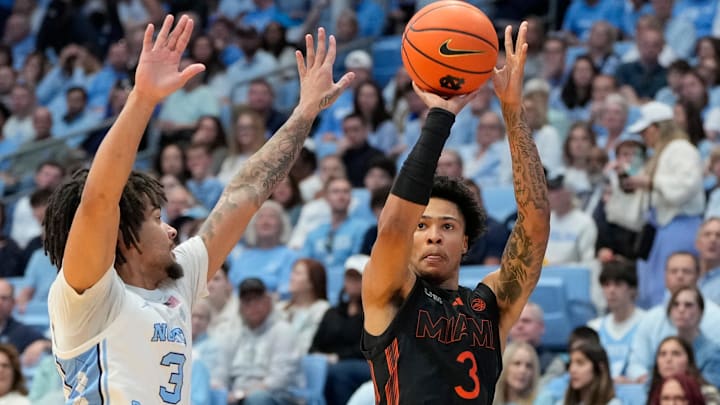
Coming off a fresh win at Chestnut Hill over the Boston College Eagles, the Miami Hurricanes return home to face the No. 14 North Carolina Tar Heels. Both teams step into the matchup with nearly identical records: Miami at 7–3 (18–5 overall) and North Carolina at 7–3 (19–4 overall).
From 1999 to 2025, the Miami Hurricanes have a record of 10-25 against the North Carolina Tar Heels, losing their last three encounters. With a Miami team that has been steadily improving under a new system with first-year coach Jai Lucas, this could be the game that puts an end to the Tar Heels' winning streak.
For Miami, this is also a battle that holds more than history - it carries heavy weight in the conference race. The Hurricanes sit sixth in the ACC, while the Tar Heels hold fifth; the two teams are separated by just one game. That slim margin amplifies the stakes and elevates Wednesday's meeting into a true showdown.
Both teams are coming off strong momentum
On Saturday, millions watched Seth Trimble of North Carolina deliver a dramatic game-winner in a storied rivalry clash against Duke. The Tar Heels are headed to Coral Gables riding a five-game surge, a streak that the Hurricanes can not afford to let run any longer.
On that same afternoon, Miami found themselves locked in a tight battle with the Boston College. The Hurricanes were playing a tie game with under four minutes remaining on the clock before Miami closed on a decisive 13–7 run to seal a six-point win.
With both teams coming off dramatic wins, this matchup becomes a referendum on discipline. It will show which side can channel its adrenaline into structure — not which one just rides the emotion of the moment.
Home strength versus road vulnerability
The Tar Heels have been flawless in their home this season, posting a 5-0 record in ACC play at the Dean E. Smith Center. But that dominance hasn’t carried over to the road. Away from Chapel Hill, North Carolina is just 2–3 in conference games, a noticeable dip that shows up in shooting efficiency, turnover rate, and how they finish possessions late.
That’s what makes Wednesday’s setting significant. The Miami Hurricanes have done well at the Watsco Center, sitting at 3–2 in home conference games, and they’ve been even better on the road at 4–1 — a sign that their identity doesn’t swing wildly based on venue. Miami doesn’t rely on home comfort to steady itself; North Carolina, on the other hand, clearly benefits from it.
With the game in Coral Gables, the environment leans toward Miami. The Hurricanes don’t need the Tar Heels to unravel — they just need them to look like the version of UNC that’s been far more vulnerable outside of Chapel Hill. And if this turns into a possession-by-possession finish, Miami’s more consistent home-and-away profile gives them an edge North Carolina hasn’t shown yet.
Miami’s numbers show a stronger margin on both ends
Miami’s offense has been highly successful in its first season under first-year coach Jai Lucas, and the numbers lay out a picture that’s been easy to see on the floor. The Hurricanes are averaging 84.2 points per game, one of the top figures in the ACC, and it isn’t an inflated number built on pace alone. It’s a product of structure: Miami gets downhill, spaces the floor in ways that force defenses into uncomfortable rotations, and plays with a decisiveness that reflects a system players clearly trust.
What gives those numbers weight is how they stack up against the North Carolina Tar Heels, who themselves put up 82.6 points per game and have long relied on their ability to pressure teams with waves of scoring. Miami edges them out, but the real difference shows up when you bring defense into the equation.
On the defensive end, Miami allows just 70.0 points per game, slightly better than UNC’s 70.5, but that half-point cannot account for the full story. The story is what the pairing of those numbers creates: a +14.2 scoring margin, the fourth-widest in the conference, compared to North Carolina’s +12.1, which is the sixth-widest.
Miami’s offense has been highly successful in its first season under Jai Lucas, and the numbers lay out a picture that’s been easy to see on the floor. The Hurricanes are averaging 84.2 points per game, the fourth-largest figure in the ACC, and this isn’t an inflated number built on pace alone. The scoring is a product of a well-designed structure: Miami gets downhill, spaces the floor in ways that scramble defenses into uncomfortable rotations, and plays with a decisiveness that reflects a system which players clearly trust.
What gives those numbers weight is how they stack up against the North Carolina Tar Heels, who themselves put up 82.6 points per game and have long relied on their ability to pressure teams with waves of scoring. Miami edges them out, but the real difference shows up when you bring defense into the equation.
On the defensive end, Miami allows just 70.0 points per game, slightly better than UNC’s 70.5, but that half-point difference does not fully reflect the picture. The story is what the pairing of those numbers creates: a +14.2 scoring margin, the fourth-widest in the conference, compared to North Carolina’s +12.1, which is the sixth-widest margin.
In a league where most games are decided in the final minute, that scoring margin matters. It points to a team that doesn’t just trade baskets but consistently creates separation and protects it. For Wednesday, that balance becomes a practical advantage. North Carolina’s offense will challenge Miami, but Miami’s numbers suggest they have enough structure on both ends to handle those stretches without losing control of the game.
The implications are straightforward. If Miami keeps its offense organized and forces UNC into longer, tougher possessions, the Hurricanes control the pace. And if the defense sticks to its standard, that +14.2 margin will become more than a number on a page and the way Miami actually wins games like this.
The team does not need fireworks. Miami needs stability. The importance lies in winning the middle stretches, keeping North Carolina from dictating the tempo, and putting themselves in a position where the final minutes look like an extension of the work they’ve already done—not a late struggle.
 Add us as a preferred source on Google