

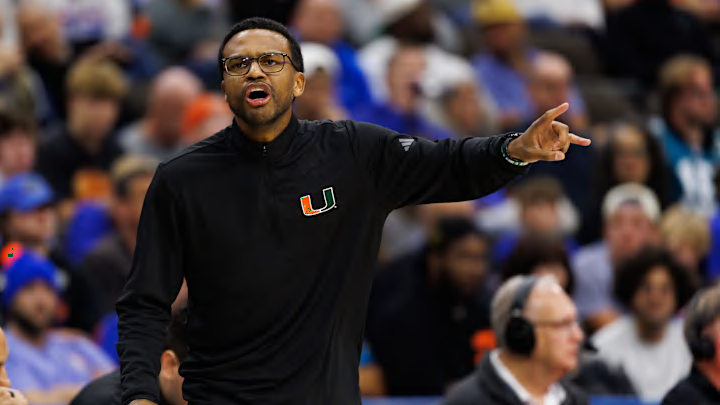
Under first-year coach Jai Lucas, the Miami Hurricanes have climbed into the ACC's top tier and put themselves in position to chase a high seed in the ACC tournament. But will the Canes be able to win close games when the whistle tightens and one cold stretch can send you home?
Flaws Jai Lucas and Miami must correct
Miami is 21-5 overall and third in the ACC at 10-3, behind Duke and Virginia. The Hurricanes are also sitting in the neighborhood of an at-large lock for the NCAA tournament, coming in around the 10-seed range on average in projections.
The Hurricanes lead the ACC in field-goal percentage (50.5%) and rank fifth in the conference in scoring (82.9 points per game). A big part of that is because Miami is shooting 58.6% on 2s, a top-20 number nationally (we'll get into why that might is so important later). They also rebound well, ranking second in the ACC in offensive rebounds (12.4 per game).
So what's left to fix before the ACC Tournament begins on March 10?
1. Free throws
Miami is shooting 67.2% at the line, which sits near the bottom nationally and at the bottom of the ACC. That is the kind of flaw that gets a team bounced early. The Hurricanes get to the stripe at a solid rate, though, so it's not like they never shoot free throws... they just don't hit them. At the end of the day this could be Miami's achilles heal. The Canes are leaving too many points on the board and if they don't fix it, Miami will lose games they should win.
2. Three-pointers, on offense and defense
Offensively, Miami's 3-point shooting is a real limiter for how high the ceiling is. The Hurricanes shoot 33.1% from deep and they make 6.3 threes per game. That is fine when you are living at the rim, finishing at a high clip and pounding the glass — which Miami certainly does well. But, it gets dicey when a team can limit those strengths.
Defensively, the problem compounds the deficiency that Miami has on offense. Miami is allowing teams to shoot 35.3% from 3, and opponents are knocking down 8.2 threes per game against the Hurricanes. In most games Miami is losing the 3-point battle. That is survivable in the regular season, but in a one game setting, it's a death sentence.
3. Depth scoring
Malik Reneau (19.7 points per game), Tre Donaldson (16.4), Shelton Henderson (14.3) and Tru Washington (11.5) combine for 61.9 points per night, which is roughly three-quarters of Miami's scoring output. Those guys have carried Miami to this spot. But, what happens when one of them has to sit with two early fouls, or when the shots aren't falling for them? It is good to have four options, but it really is thin after that.
The production behind them has been more role-based. Ernest Udeh Jr. is a monster on the glass (9.5 rebounds per game) and helps define Miami's toughness, but he is not a spacing/scoring piece. Dante Allen and Marcus Allen sit in that next scoring bunch, but Miami's margin for error is smaller than some might think. In March, you do not always get your A-game, and the depth will have to show up at some point if they want to make a deep run.
Miami is still an impressive team
The Hurricanes are in the ACC's top three for a reason. They score efficiently, they rebound, and they defend well enough to keep their floor high. But the final step — making free throws, protecting the arc, shooting from long-range and finding scoring from the bench — will need to be addressed to go on a run.
 Add us as a preferred source on Google