

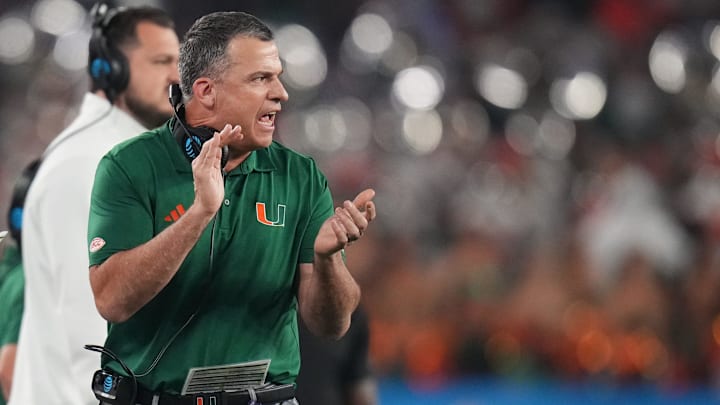
Mario Cristobal has a formula, and it has his beloved Hurricanes one win away from their first national championship since 2001. That formula starts at the line of scrimmage, with elite high school recruiting on both sides of the trenches, but another clear tenet of his philosophy for roster construction in the modern age of college football is to pay the premium for a veteran quarterback.
This year, Miami has hosted Arizona State transfer Sam Leavitt and has been rumored to be connected to Nebraska transfer Dylan Raiola, but it doesn’t appear that either player is at the top of the program’s wishlist. That’s because Miami, according to Tuscaloosa News, has put a $6.5 million deal on the table for Alabama quarterback Ty Simpson.
Miami has reportedly offered Alabama QB Ty Simpson $6.5 million to enter the portal
Simpson has declared for the 2026 NFL Draft and is largely expected to be QB3 off the board behind Indiana’s Fernando Mendoza and Oregon’s Dante Moore. Plus, with the 20-year-old Moore’s future uncertain, Simpson could slide up to QB2 and likely ensure a spot in the first round.
As a first-round pick, even the 32nd overall pick carries a contract value of over $16 million for four years with a fifth-year option. If the reports that NFL general managers view Simpson as a first-round pick, that money is hard to pass up, and it explains why Miami would have to reset the QB market to get him to stay in school and enter the transfer portal.
Simpson has just one year of starting experience, a red flag to NFL evaluators. But in that one year, he was instantly one of the best quarterbacks in the country, carrying an Alabama offense that ranked 131st in the country in rushing success rate and finishing with 3,567 yards and 28 touchdowns to five interceptions.
Simpson had an immense amount of playmaking responsibility on his shoulders from Alabama’s Week 1 loss to Florida State on through the rest of the year, and aside from a few exceptions, he continually delivered. He aggressively hunts big plays over the middle of the field, throwing with accuracy and anticipation from the pocket, and has enough athleticism and arm strength to create outside of structure and push the ball downfield off-platform. That combination is why the NFL is interested in him, and why Miami wouldn’t be insane at all to pay him the $6.5 million, or more, that it would command to pry him out of the draft.
Mario Cristobal’s not afraid to pay a premium for QB certainty
Cristobal’s plan to pay up for veterans has worked out each of the last two seasons, with Cam Ward nearly carrying Miami to the College Football Playoff and Carson Beck getting the Canes there. However, paying for a veteran in their final season of eligibility means you need to replace that player each offseason, and that presents its own challenges. Yet, the Canes are all-in on portal QBs.
Over the last few years, Miami hasn’t exactly ignored the high school quarterback market, adding four-star Luke Nickel in the 2025 class and three-star Dereon Coleman in 2026, but Cristobal and his staff have opted out of the high-priced battles for five-star high school talent at the position. And though it costs them big each offseason, their reasoning is completely sound.
With the boom of the transfer portal, it’s a near certainty that the five-star quarterback you recruit won’t finish his career at your school, even as multi-year deals become increasingly prevalent. So, why pay up for the player out of high school and pour years of effort into their development, only for another deep-pocketed program to reap the ultimate rewards?
As much as the NCAA may want it to be, the revenue-sharing pool is not a hard cap and is not enforceable as one unless and until there is a collective bargaining agreement. So, Miami can comfortably spend outside the cap to ensure that it has its quarterback and a talented roster around him.
In the NFL in 2025, the highest-paid quarterback, Dak Prescott ($60 million), made 300 percent more than the highest-paid coach, Andy Reid ($20 million). For years in college football, coaches were paid for their ability to get players. Now that programs can pay players directly, there’s no reason that it won’t head in a similar direction with player salaries eventually surpassing head coaches.
$6.5 million for a college quarterback may seem insane, but for a top-tier player at the position, it’s still an underpay. The Canes paid Carson Beck $4 million last offseason, and with the ACC allowing schools to keep 100 percent of the CFP prize money, the Canes have already taken home $20 million for this run, and that’s aside from ancillary financial benefits that come to a program and university by making it to the national championship.
I think it’s safe to say that Miami doesn’t regret writing that check to Beck and would happily sign this $6.5 million one for Simpson.
 Add us as a preferred source on Google