

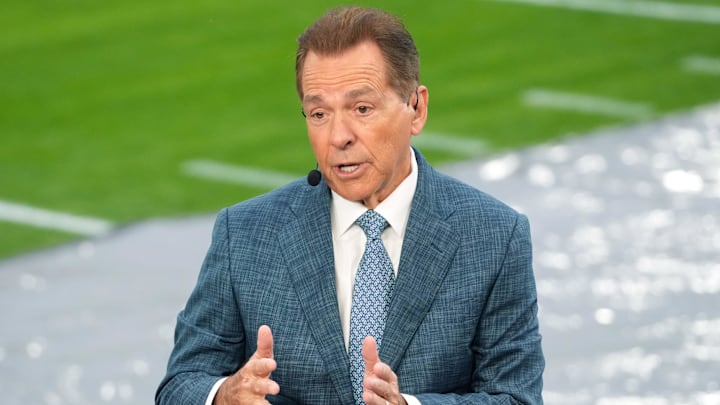
Miami has been one of the programs willing to spend, adapt and play aggressively in the modern NIL era. Nick Saban's latest idea would make that harder.
The former Alabama coach has again pushed for college football to create more financial balance, this time by calling for a system that looks more like a salary cap. Saban said on "The Paul Finebaum Show" that one team should not have a $40 million roster while another has a $5 million roster, adding that pro leagues have caps or similar systems to create parity.
That sounds good for schools that are falling behind financially, but would be a much different conversation for programs like Miami, which have leaned into the new world of college football instead of waiting for it to slow down.
Nick Saban calls for a salary cap to be implemented across college football 🤔💰
— SEC Country (@SECcountry) May 8, 2026
(via The Paul Finebaum Show) pic.twitter.com/BjGQVRGxwq
Miami has embraced the new model
Miami's NIL operation has been one of the central pieces of the program's rise under Mario Cristobal. Canes Connection, the official NIL collective of Miami athletics, was founded in 2022.
Miami has been tied to high-profile NIL and transfer activity in recent years, including quarterback Darian Mensah's move after a legal dispute with Duke over a reported two-year, $8 million NIL agreement. Duke and Mensah reached a settlement before he joined Miami.
The current system already has a cap
College athletics already changed dramatically after the House v. NCAA settlement. Schools can now share revenue directly with athletes, with the 2025-26 cap set at $20.5 million per school (expected to rise to about $21.3 million for 2026-27).
Revenue sharing is only one piece of the payment system. Outside NIL deals still exist, and collectives remain part of the landscape. The House settlement also created a process for reviewing NIL deals above $600 through a clearinghouse, with the goal of determining whether deals tied to associated entities are fair market value.
If a cap was implemented, the Hurricanes would still have location, history, NFL development, Cristobal's recruiting track record and a strong offensive and defensive line identity. Those things will matter no matter what happens in the future.
But it would change the way Miami competes for top-tier talent. If every program had the same spending limit, Miami would lose some of the separation it can create through NIL resources. That would push the Hurricanes into a more traditional recruiting model.
 Add us as a preferred source on Google